Jasmine Tea
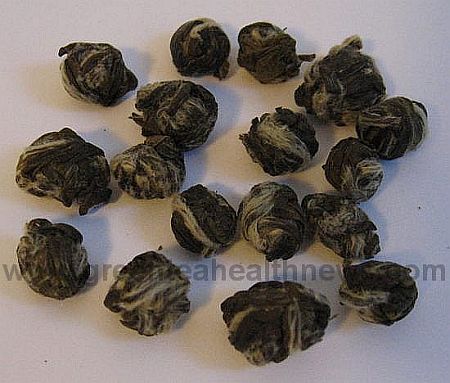
Tea for lovers
Jasmine tea is for romance. It has a light, refreshingly fragrant taste with endless versatility.
Like Champagne, lower grades can have a stronger flavor, while the highest grades are more subtle, delicate and smooth.
What does it look like?
Leaf appearance: Most of these teas are made with green tea varieties, but you will also find pouchong and black teas scented with jasmine flowers.
The scented leaf can be processed into many different shapes-- twisted, curled, rolled into tiny balls like the Dragon Phoenix Pearls seen above, or tied together into display teas.
Brew: The liquor is almost colorless, perhaps a very pale light green or amber.
It has a magical fragrance to make you forget all your troubles.
When to serve it
Choosing the occasion is a matter of your personal style.
You can savor it when you wish to capture the romance of summer moonlight, or you can drink it all the time with any food.
It can be served with strongly flavored foods as well as alone. It is good with curries, chicken and fish, and vegetarian dishes.
A good quality jasmine green will work beautifully with fruit and flower salads, or desserts made with flowers, or soft cheeses with pressed flowers.
How to make jasmine tea
Steep about one half teaspoon of leaf per cup in water from 170F to 190F for two minutes.
You can repeat the steeping up to two times.
What is its history?
The jasmine plant was brought to China from Persia sometime in the third century AD.
But jasmine tea did not become popular in China until the Song Dynasty (960-1270 AD).
Traditional Chinese medicine recommends it to decrease nervous tension, to increase circulation, and to break down saturated fat.
Today, jasmine is known in alternative health care as an effective anti-depressant--good for anxiety, lethargy, sadness, lack of confidence, fearfulness, paranoia, post-natal depression, and menopause problems. Along with raspberry leaf, it has been used to help childbirth and milk production.
It can help release muscle and joint pain, including chronic back pain. It is also considered a romantic enhancer, helping all aspects of love.
How is jasmine tea made?
Most start with a Chinese green tea for a base. Some will use pouchong/oolong or black variety. The leaves are plucked and processed in April and May and then kept dry, waiting until the jasmine flowers bloom in August and September.
The flowers are gathered in the morning and kept cool. When they "pop" open in the evening, they are placed with the tea leaves so that the scent can be absorbed over the next four hours. The spent flowers are removed.
This will be repeated from two to seven times over a month's processing before it is ready for sale.
Where is it made?
The most famous area is Fuzhou (Foochow) in Fujian (Fukien) Province, China.
It is also made in Taiwan, and other areas.
Other names include Yin Hao, Mo Li Hua Cha, and Dragon Phoenix Pearl.
What is the best jasmine tea?
Grading depend on the number of scentings over a month and the proper proportion of flowers to tea leaves.
Lower grades use only two or three scentings. The scent will be stronger but will disappear quickly.
Higher grades will use seven scentings over a month's time, which gives a more subtle and long-lasting fragrance.
An excellent way to preserve the delicate scenting is to roll the tea leaves into tight balls as seen in the photo of Dragon Phoenix Pearls at the top of this page.
Yin Hao is considered the finest grade.
Yin Hao is James Bond's selection. James Bond, 007, rarely drinks tea, but he is a connoisseur of the finest things whether of danger or love. So when he does drink it, it is always Yin Hao.


Sean Connery Art Print
Buy at AllPosters.com
Where is it made?
The most famous area is Fuzhou (Foochow) in Fujian (Fukien) Province, China.
It is also made in Taiwan, and other areas.
Other names include Yin Hao, Mo Li Hua Cha, and Dragon Phoenix Pearl.
Sign up here for free subscription to the Green Tea Health Newsletter:
What's Your Favorite Green Tea?
Tell us about that favorite green tea that always puts you in the right mood for a great day!
What Other Visitors Have Said
Click below to see contributions from other visitors to this page...
Yin Hao Jasmine Not rated yet
I was introduced to Yin Hao Jasmine tea in San Francisco in 1989. It became my only morning tea each day to this day, as suppliers came and went. The …
Jasmine tea needle leaf Not rated yet
I have just recently started to drink Jasmine tea, reason being because I was amazed at all the health benefits that come from drinking green tea.
…
Friends And Family
Are you a member of a social networking site like Facebook, Google +, or the popular Twitter? If you like my website, share it with your friends and family! I appreciate it also, and thank you in advance.
or email it:
http://www.green-tea-health-news.com/jasmine-tea.html
Did you like this page on jasmine tea? Here are more gourmet teas
This page was last updated by Sharon Jones.
New ebook offers
Subscribe to the free e-zine, Green Tea Health News for new ebook offers, link archives, new recipes, helpful products, hot deals, and more.Subscribe now and don't miss a single issue.

This website supports
planting Giant Sequoia trees.Find out more!