Gunpowder Green Tea
Gunpowder green tea FAQ
- taste,
- description,
- serving ideas,
- preparation,
- history,
- manufacture,
- grades:
What does this tea taste like?
The highest quality gunpowder teas have a naturally sweet and soothingly mellow taste.
In the better grades, the pungency is balanced and smooth, rather than harsh.
These brewed teas may occasionally have a hint of smoky notes, and there is usually a light lemon aftertaste.
This is a great choice for breakfast and as a "coffee break."
It is recommended as a substitute for people trying to reduce their coffee intake, as the taste appeals to coffee lovers.
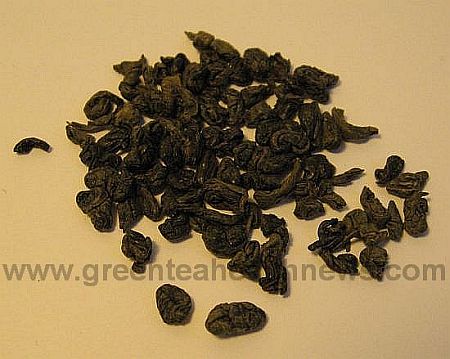
Tea leaves rolled into balls
This Chinese green tea is famous for the unique leaf shape, said to resemble 18th century gunpowder pellets.
Each silvery green leaf is tightly rolled into a tiny ball during processing, a technique perfected over centuries to preserve freshness.
The highest grades do not unravel in storage.
Once in the cup, the pellets open up into large olive green leaves.
Gunpowder tea liquor can be darker than some oolongs.
It can vary from a light amber to a strong coppery color with a light green tint to a brighter green olive shade.
When to serve it
Since gunpowder green tea is definitely a daily beverage, it is particularly useful when you need to conquer a long list of "Things To Do."
It provides both the mental and muscular stimulation needed to help you organize, and then take effective action to get the job done.
Think of choosing this tea when you're having a day like this Major in the movie A Bridge Too Far:
- Major: "I've got lunatics laughing at me from the woods. My original plan has been scuppered now that the jeeps haven't arrived. My communications are completely broken down.
Do you really believe any of that can be helped by a cup of tea?"
Corporal: "Couldn't hurt, sir."
Tea serving suggestions
Gunpowder green tea is one of the few green teas that easily goes with red meats. It works with hamburgers, pizza, and BBQ beef and pork.
Try it with chicken and fish dishes that use stronger spices like garlic, basil, and mustard.
When flavored with mint, usually called Moroccan Mint, it helps cleanse the palate during a richly spiced meal.
Flavored with mint or lemon, it is a very refreshing iced tea.
And of course, as a "coffee break," it helps balance high fat or sugar pastries.
How to prepare it
Because of the tightly rolled shape, this Chinese green tea is more concentrated.
Use just 1/2 teaspoon per cup and water just before the boil, about 180F. Steep around 4 minutes.
History of gunpowder green tea
It was originally named Pearl or Zucha, and has been known since the Tang Dynasty (618-907 AD), famous for their sculptures of horses.

Horse and Groom,...
Buy This at Allposters.com
A favorite of Emperor Kang Xi (1661-1722 AD) of the Qing Dynasty, it became an Imperial Tribute tea.
The current English name is attributed to a British clerk in the 1800's who thought that the processed leaves resembled pelleted gunpowder used for cannons.
It was one of the first Chinese teas to be exported in the early 1600's. By the 1700's it was extremely popular in Europe and the Colonies (now U.S.A), and was marketed under the names Green Pearl Bohea and Hyson.

Constitution Day...
Buy This at Allposters.com
It was probably the Hyson tea that kept Thomas Jefferson, John Adams, and George Washington focused on their cause of American independence and the common good.
Jefferson was known to go through over 20 pounds of the highest quality Hyson annually.
By 1860, almost two-thirds of tea imported in the U.S., was Gunpowder green tea.
The name Bohea was discontinued and the name Hyson eventually was used only for varieties with a long, twisted leaf rather than the pearl shape.
How do they make gunpowder green tea?
Originally, all tealeaf rolling was done by hand.
Now, both plucking and rolling is done by machine to increase production, with the exception of the highest grades that are still hand-rolled.
The tight shape gives these teas the best shelf-life of any tea, green or black.
How is it graded?
Pingshui Temple of Heaven is considered the highest grade.
Since it is produced in a variety of areas now, the tealeaf can vary. Look for dried green tealeaf that is tightly rolled, consistent in silvery green to olive green color, and shiny rather than scorched.
The liquor should be a bright clear copper to olive color, not yellow or cloudy. The aroma should last and the taste remain mellow, not harsh.
Where is this tea grown?
Gunpowder green tea originated in Shaoxing City of the Pingshui area of Zhejiang Province, China (southwest of Shanghai, across Hangzhou Bay).
Now it is also produced in Guangdong Province, Anhui Province, Hunan Province, and Fujian Province of China.
Ceylon and Taiwan/Formosa are also producing their own gunpowder green teas.
Other names include pearl and zucha.
FAQ
How much caffeine in a cup of green tea? | Which green tea has more caffeine? | How to choose your caffeine level | 21 tips for choosing green tea caffeine levels | What about decaffeinated green tea? | Effects of caffeine: positive and negative | Is caffeine dangerous?
Sign up here for free subscription to the Green Tea Health Newsletter here:
Tell A Friend
Are you a member of a social networking site like Facebook, Google +, or the popular Twitter? If you like my website, share it with your friends and family! I appreciate it also, and thank you in advance.
or email it:
http://www.green-tea-health-news.com/gunpowder-green-tea.html
Did you like this page on gunpowder green tea? Here is more about gourmet selections
This page was last updated by Sharon Jones.
New ebook offers
Subscribe to the free e-zine, Green Tea Health News for new ebook offers, link archives, new recipes, helpful products, hot deals, and more.Subscribe now and don't miss a single issue.

This website supports
planting Giant Sequoia trees.Find out more!